You Think You Know What You’re Eating? Probably Not
These days, you think you know what you’re eating. There’s never been a shortage of food on your plate – even with a world population that keeps growing, supermarkets stay stocked, shelves never run empty. It almost looks like a miracle of abundance. But could you actually explain how that’s even possible?
The answer is hiding in the fine print most of us never read. Pick up any package, flip it over, and look at the ingredient list. Do you recognize half the names? Probably not. And it’s a lot easier to give up trying than to admit you have no real idea what you’re actually eating.
This article isn’t here to scare you off what you buy. It’s here to stop you from buying blind.
The Fruit That Ripened in a Warehouse, Not on the Tree
Take a good look at the next apple or banana you buy: perfect, glossy, without a single blemish. A little too perfect, maybe. And that’s where the first surprise nobody tells you about at the supermarket begins.
A large share of the fruit that ends up on shelves is picked while still green – long before it’s actually ripe – specifically so it can survive shipping and storage without spoiling along the way. The problem is, green fruit has neither the taste nor the texture needed to sell. The industry’s solution: seal it inside closed chambers and expose it to ethylene gas, the very same natural hormone plants release when they ripen on their own in the sun – except here, the process is controlled and artificially sped up.
It’s a legal, regulated process, used for decades. The issue isn’t safety – it’s silence. No one tells you, on the packaging, that this fruit never actually finished ripening on the tree. And the difference is real: naturally ripened fruit develops more sugars, more aroma, and a more complete nutritional profile than fruit “forced” to catch up after picking. That gorgeous but completely flavorless piece of fruit we’ve all bitten into at some point? That’s probably it.
Fertilizers and Pesticides: The Invisible Price of Perfection
The same “perfection at any cost” logic applies to almost everything that comes out of the ground. Modern agriculture relies heavily on synthetic fertilizers to force exhausted soil to produce more, and on pesticides to make sure no pest ruins the harvest before it reaches the truck.
This isn’t some hidden secret – it’s the norm for large-scale agricultural production, almost everywhere in the world. Within the European Union, maximum residue limits are set for every type of food, regularly reviewed and enforced. Once again, the problem isn’t that it’s illegal – it’s that almost no one knows these limits even exist, what they mean, or why a perfectly straight cucumber without a single mark is, statistically, more likely to have received more chemical treatment than the crooked, imperfect one nobody wants to buy.
This isn’t about seeing poison in every lettuce leaf. It’s about understanding that the visual “perfection” you unconsciously demand at the supermarket comes with a cost – one that almost never shows up on the price tag.
The Meat and Fish That Grow Up Too Fast
If you thought this rush only applied to fruit and vegetables, the animals we eat follow the exact same path – in an even more striking way.
In 1960, an industrially farmed chicken took around 80 days to reach 2 kilograms. Today, it reaches an even higher weight – around 2.6 kilograms – in just 42 days. That’s not magic, and it’s not hormones (banned in animal farming across the European Union): it’s the result of decades of extremely precise genetic selection, combined with industrial feed specifically formulated to maximize weight gain in the shortest time possible.
The problem is that the animal’s biology doesn’t always keep up with that pace. Many of these animals become so heavy, so fast, that their own legs can barely hold up their weight – a real, well-documented sign of chronic physical stress, not a figure of speech. The same pattern repeats in intensive aquaculture: fish raised in high-density farming systems, also fed formulas designed to accelerate growth all the way to slaughter.
And that stress doesn’t disappear once it hits the plate. Meat and fish produced at this accelerated pace tend to show real differences in texture, flavor, and nutritional composition compared to animals raised at a slower, more natural pace — a difference that, once again, the packaging almost never mentions.
Decoding E-Numbers: No Panic, Just Knowledge
Now for the part that causes the most confusion: that string of “E” followed by numbers on the ingredient list. And here’s where it’s worth pausing a common reflex – the assumption that any “E” is automatically suspicious.
It isn’t. E-numbers are actually the European system for identifying food additives – colorings, preservatives, antioxidants, emulsifiers, thickeners, flavor enhancers, and sweeteners – all evaluated and regulated by the European Union before they can be used. Many are completely harmless substances hiding behind intimidating technical names: E300, for example, is simply vitamin C. E330 is citric acid, the same substance naturally found in citrus fruit.
But that doesn’t mean every additive is created equal, or that none of them deserve a closer look. Nitrites (E249 to E252), used mainly in processed meats like ham and sausages, have been linked to health concerns when consumed in excess on a regular basis. Certain artificial colorings are already required, by EU law, to carry a warning label due to their link to hyperactivity in children.
The goal isn’t to memorize a list of 300 codes. It’s to understand that “E” doesn’t automatically mean “bad” – but it doesn’t automatically mean “harmless” either – and that it’s worth learning to tell the two apart, instead of reacting blindly to any letter followed by a number.
The Marketing That Sounds Great But Says Nothing
Once you’ve decoded the ingredients, there’s still the packaging itself to decode – because many of the words on the front of a product were chosen to sell you trust, not to inform you.
“Natural” has, in most cases, no strict legal definition forcing it to mean what you’d assume. “Light” can simply mean fewer calories than the original version of the same product – even if that original version wasn’t particularly healthy to begin with. “No added sugar” is technically true for products that replace sugar with artificial sweeteners, something the phrase alone never reveals.
None of these words are illegal. All of them, however, are designed to create a positive impression before you ever read the real ingredient list – the one, as we’ve already established, most of us never actually read.
What to Actually Do About It
You don’t need to become a food chemistry expert to make more informed choices. You just need to shift a handful of small habits:
Always flip the package before deciding. The front of the product is advertising. The ingredient list on the back is the real information.
Look for shorter ingredient lists. A useful rule of thumb, not an absolute one: the longer and harder-to-pronounce the list, the more likely you’re looking at a highly processed product.
Don’t fear everything blindly – get informed selectively. You don’t need to reject a product just because it contains an E-number; you need to know which one it is, and decide based on that information, not on fear.
Pick one thing a week to really dig into. A product you buy regularly, whose ingredient list you’ve never actually read. One small habit, repeated, teaches you more than any single article ever could.
This Isn’t About Fear. It’s About No Longer Eating Blind.
The abundance you see at the supermarket isn’t an accident or a free miracle – it’s the result of an entire system, carefully built, that rarely explains itself. That doesn’t mean you need to fear what you eat. It means you deserve to know what you’re actually putting on your plate, and to choose with that information, not without it.
Next time you’re at the supermarket, flip the package. Read. Question. That’s the first step toward no longer being just another distracted shopper – and becoming someone who chooses with their eyes wide open.
Reading the label is where it starts. The harder question comes next: if you’d rather not eat what a factory assembled, who assembles it instead?
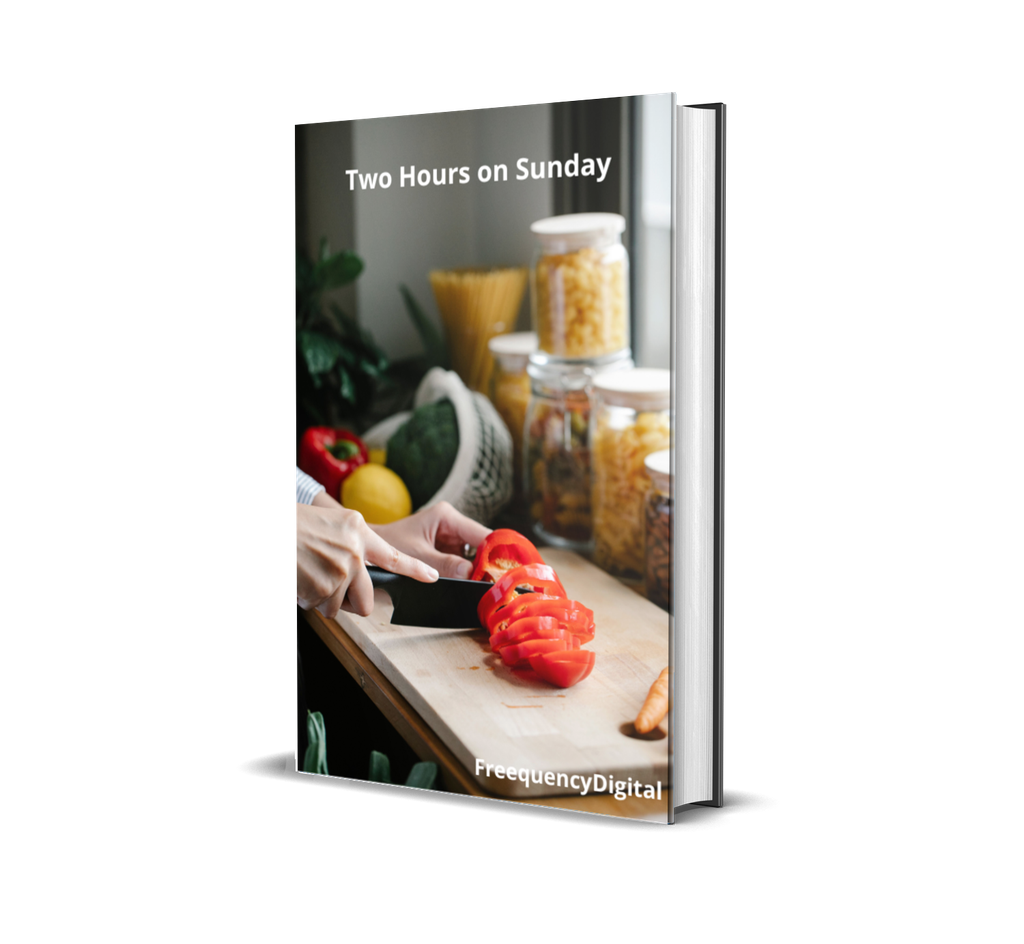
Two Hours on Sunday is the practical answer. Six real bases — things you can name — prepared in one go on Sunday and combined differently through the week. Not fifty recipes. Six ingredients you chose yourself, and a week of meals that owe nothing to a label.