Meal Prep for the Week: Why You Give Up by Wednesday
You’ve tried meal prep for the week before.
Probably on a Sunday in January, with new containers bought specially, a menu written on the fridge door and the firm intention that this time it would be different.
And by Wednesday it was over.
What happened to you happens to almost everyone. The conclusion you drew was that it came down to you: lack of organisation, lack of discipline, the kind of person who doesn’t finish things.
It was none of that.
You gave up because the plan was badly built – and it’s worth understanding where, because meal plans always fail for the same four reasons, and not one of them is about you.
1. The chain
Open any batch-cooking book at random and you’ll find a plan shaped like this: Sunday you roast a chicken, Monday you eat the roast chicken, Tuesday the rest becomes a salad, Wednesday the carcass becomes stock, Thursday the stock becomes soup with the vegetables left over from Tuesday.
On paper it’s elegant. Nothing is wasted and each day feeds the next.
In practice: on Tuesday you had lunch out with a colleague. No chicken left. Wednesday, no stock. Thursday, no soup. One missed day drags the next three down with it – and you’re also left with raw vegetables in the fridge that now have nowhere to go, and that you’ll throw out on Saturday.
That’s what a chain means: each day is the raw material for the next. It looks like efficiency and it’s the opposite, because chains always break at the weakest link – and in a week with work, children and the unexpected, there is always a weak link.
2. The perfect-week plan
The second flaw is the first one’s brother, but subtler.
The plan assumes the week runs the way it was written. Five identical days, five lunches at the same hour, five times with the same appetite and the same mood.
Except there’s the child who wakes up with a fever. The meeting that runs into lunch. The day you want something hot and all you have is salad. The colleague’s invitation you’re not going to turn down over a lunchbox.
None of that is a disaster, and none of it is a lack of discipline. That’s a week.
A system that demands nothing gets in the way, built into a life where everything gets in the way, has no way of surviving. And the worst of it is what it does to the head of the person following it: every deviation starts to feel like a personal failure, when it’s simply life happening exactly as promised.
3. The door that isn’t there
This is the real culprit, and it’s the easiest to fix.
Wednesday evening, the plan is in pieces. And the feeling you get is that to come back you’d have to start again from the beginning: redo the list, go shopping, wait for Sunday.
Because starting again is expensive, you don’t start again.
You wait for next Sunday. And next Sunday, the memory you bring with you is of a failed week, which makes the Sunday after that heavier than the one before. Two or three turns of that and the conclusion settles in: this isn’t for me.
Notice that the problem wasn’t Wednesday. Wednesday was going to happen anyway.
The problem was that no door existed closer than the beginning.
4. The upkeep that eats the gain
The last flaw is the quietest, and it’s the one that makes the most organised people quit.
Some systems work – they just cost more to maintain than they save. The spreadsheet with the menus. The app where you log the meals. The list that changes every week and has to be rewritten every week. The freezer inventory.
A system has to return more than it costs to keep running. When it demands more tracking than the simplification it delivers, the mental load goes up instead of down.
And at that point, abandoning it becomes the right decision. Anyone who walks away from a system like that hasn’t failed: they’ve done the arithmetic properly.
What makes meal prep for the week actually last
The four reasons share one origin. They’re all the consequence of a design decision nobody questions because it seems obvious: cooking meals.
The alternative is to cook something else.
You don’t cook meals. You cook independent bases.
A base is a finished component that needs no other one to exist: roast chicken, dressed chickpeas, vegetables from the oven. Each lives alone in the fridge and owes nothing to the others.
The meal isn’t cooked – it’s assembled, on the spot, from two or three bases and a sauce.
Look at what that solves in one move. Missed a day? The bases are still there tomorrow. Fancied something else? You change the assembly. Got a base left over? It rolls into next week.
A chain is worthless the moment a link breaks. A pile of blocks, when you take one away, is still a pile of blocks.
And it solves the fourth flaw too, the upkeep one – because if the bases don’t change from week to week, the shopping list is always the same. You write it once, photograph it, and never write it again. No menu to plan, nothing to log anywhere. That’s the difference between a system that gives you time back and one that charges you a weekly rent in attention.
Six bases are enough for the whole week, and they’re made in two hours on Sunday – but that’s the mechanical part, and the mechanics are the easy part once you understand why the rest kept failing.
And the Wednesday it breaks anyway?
Because it will break. That isn’t a possibility, it’s a certainty – not through lack of discipline, but because you have a life with work, with people and with the unexpected.
The difference is that with independent bases, Wednesday evening you don’t have zero. You open the fridge and what’s missing are the two bases that keep the shortest time and that should have been eaten already. The other four are there.
You don’t start again from the beginning. You start again from where you are.
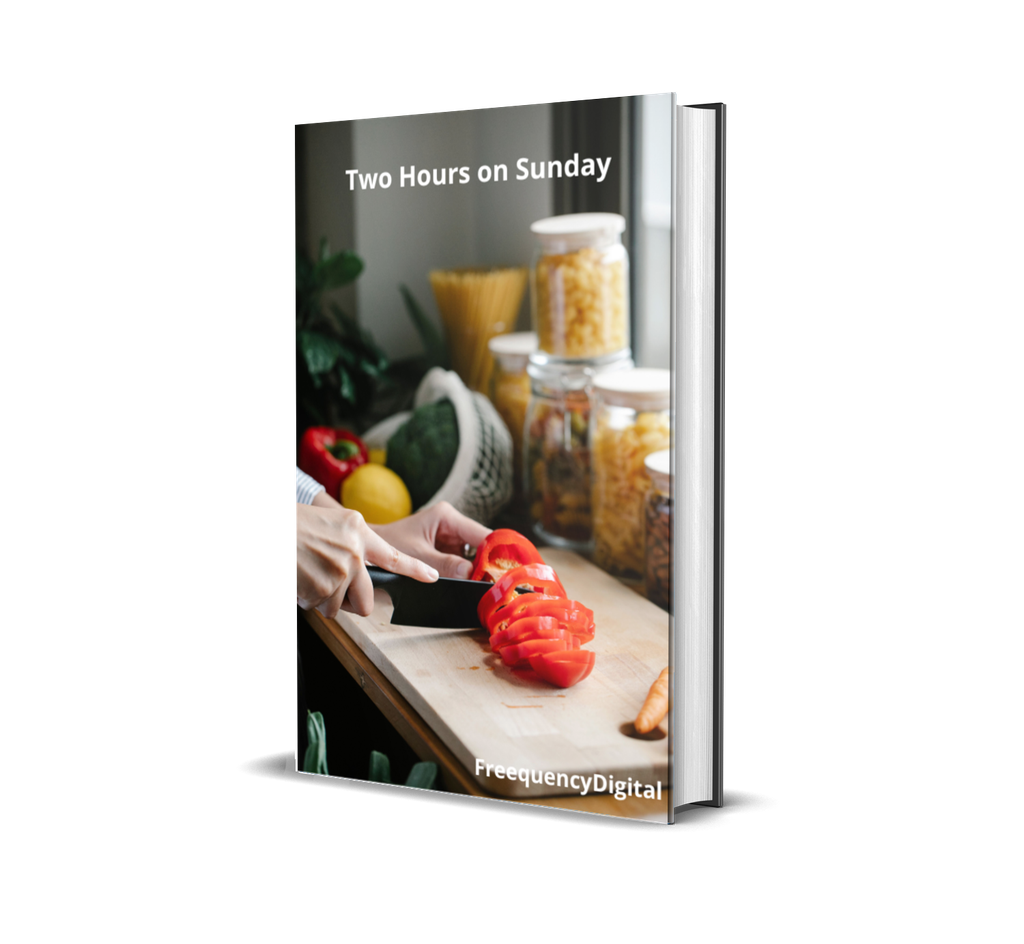
Two Hours on Sunday is the complete system: the six bases with quantities, times and temperatures, the minute-by-minute clock for the two hours, the assembly table that gives five different meals without repeating a single sauce, and four recovery protocols for the week that goes wrong – from fifteen minutes to one hour, depending on the damage.
It includes the part no other book writes: the lunchbox at work. The microwave that isn’t there, the smell in an open-plan office, the sauce that turns everything soggy by Thursday.
All three language versions in a single purchase.