You Spend More Time Looking at a Screen Than at Your Kids — and You Don’t Even Notice
You’re in the living room. Your child runs up to show you a drawing, a tower of blocks, a bug they found in the garden. “Look, look!” And you look – but only halfway, because your eyes are still glued to the screen you were holding two seconds ago. You say “that’s nice” without really seeing it. They walk away happy, convinced you noticed. You’re left with that strange, hard-to-name feeling of having been there without really being there.
If this sounds familiar, you’re not alone – and, more importantly, it’s not because you’re a bad parent. It’s because the phone in your hand was designed, literally designed by teams of engineers and psychologists, to be more interesting than almost anything around you, including your own children.
It’s Not a Lack of Willpower – It Was Built This Way
There’s a technical term for what happens when you open Instagram, TikTok, or even your email “just to check quickly”: variable reward. It’s the same principle used in casino slot machines. You never know what’s coming next – it could be a boring video, something hilarious, a shocking headline, a like that makes you smile. That uncertainty is addictive precisely because the brain loves rewarded unpredictability. It’s not a personal weakness. It’s billion-euro behavioral engineering, fine-tuned year after year to keep you scrolling just a little longer.
Thinking “I just need more willpower” to fix this is like blaming yourself for feeling hungry when you smell fresh bread. That smell was designed to make you hungry. Infinite scroll was designed so you never feel satisfied and always want a little more.
The Escape for Anyone Who’s Tired, Worried, or Short on Money
There’s another layer to this that rarely gets talked about, and it might be the most important one: the phone isn’t just competing with your children for your attention – it’s competing with your exhaustion, your unpaid bills, tomorrow’s worries.
You get home after a hard day. Your body wants rest, but your mind is still full – of work, of money, of everything still left to do. And that’s exactly when the phone offers you the most tempting thing in the world: switching off with zero effort. It asks nothing of you. No thinking, no deciding, no need to be present. Just a swipe, and your mind empties out for a few minutes.
A conversation with your child, on the other hand, demands real presence. It requires energy you sometimes feel you no longer have. And that’s exactly where the phone wins – not because it’s more fun than your family, but because it’s easier in the moment you’re running on empty. It’s a cheap emotional painkiller, always within reach. The problem is, unlike a real painkiller, this one never treats the cause – it just delays the tiredness, quietly stealing the time you needed to actually recover.
Everyone Else’s Highlight Reel, Compared to Your Real Life
As you scroll, you see someone else’s tidy home, another family’s vacation, a third person’s smiling, perfectly behaved kids. What you don’t see is the moment right before the photo, the meltdown that happened five minutes later, the bill that person is also trying to pay. You’re only seeing the single best moment, carefully chosen, out of an entire life – and comparing it to your actual day, with dishes in the sink and a child crying because they don’t want to put their coat on.
That constant comparison feeds a dangerous cycle: you feel like your life doesn’t measure up, that creates discomfort, the discomfort calls for an escape, and the fastest escape is… going right back to your phone. The very place that made you feel bad offers itself, instantly, as the solution to the discomfort it just created.
Why It’s So Hard to Disconnect
It’s not just about willpower, or the app itself – it’s a whole set of things stacked against you:
Constant notifications. Every buzz is a small demand for attention, designed to feel urgent even when it isn’t.
The pressure to always be reachable. You feel like if you don’t respond right away, something will go wrong – at work, with friends, at home.
The fear of missing out (FOMO). That sense that if you don’t check now, you’ll miss something important – even though, deep down, you know that’s rarely true.
The automated habit. After months or years, picking up your phone stopped being a conscious decision. It became a reflex, like scratching an itch – you do it before you even realize you have.
None of these factors happened by accident. They were all, in one way or another, optimized to keep you hooked – not because anyone wishes your family harm, but because your attention is worth money to whoever builds these platforms. The longer you stay, the more they earn. It’s that simple, as uncomfortable as it is to admit.
What’s Actually Being Lost
It’s not “time,” as some abstract concept, that gets lost in these moments. It’s much more concrete, much more irreplaceable things:
It’s your child’s first step, which you only caught out of the corner of your eye, because you were replying to a message that could have waited.
It’s the meltdown that passed quickly, simply because someone looked them in the eye and said “I’m here,” instead of staying head-down.
It’s the dinner conversation that never happened, because everyone was on their own screen, a meter apart, but emotionally miles away.
These things don’t come back. There’s no “replay” for your children’s childhood. One day, sooner than you think, that same child who runs up today to show you a drawing will close their bedroom door and say “leave me alone.” That’s normal – it’s part of growing up. But the question that remains is: in the years before that happens, were you really there, or just physically present while your mind was somewhere else?
Your Phone Won’t Remember Your Kids Growing Up. You Will.
No one is asking you to give up technology, or to feel guilty for every distracted moment – that doesn’t help anyone either. What’s left here is just an honest invitation to notice the pattern, without drama, without miracle promises.
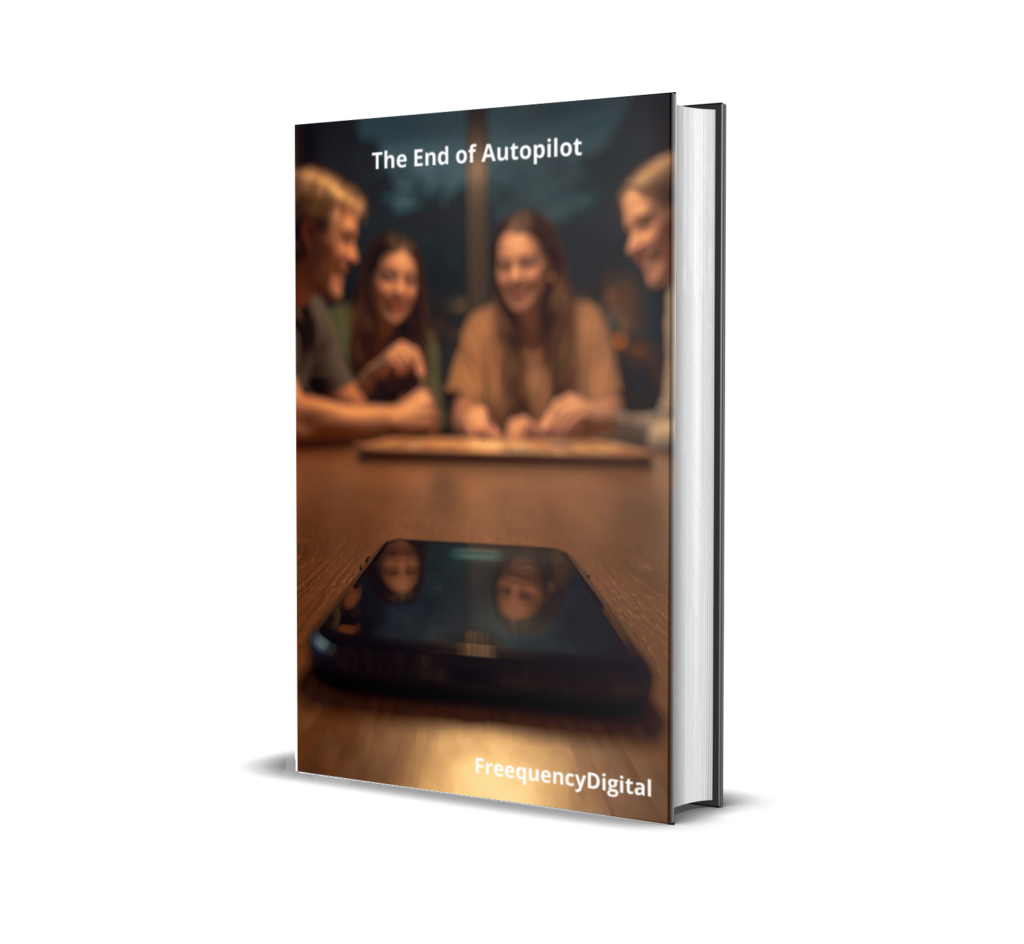
Knowing this doesn’t get solved with more information – deep down, you already know you spend too much time on your screen – that’s exactly why we created our e-book: The End of Autopilot – A 10-Day Challenge to Break Your Phone Addiction and Take Back Control of Your Real Life, with one concrete action each day, built for anyone ready to actually start changing this, one small step at a time, as many times as you need throughout the year. It’s not about theory. It’s about slowly coming back to being present, before these moments turn into memories you wish you’d truly lived.
Remember this. Act on it. Do it for yourself, do it for them – for the moments that, once lost, never come back.